
AI & machine learning
Data Pipelines for Machine Learning: From Ingestion to Training (2026 Guide)
Jiri Knesl 13 min read
Most of what decides whether a machine-learning system works is the data pipeline behind it, not the model on top.
Table of Contents
- Comparison: Old vs. New ML Pipelines
- ❶ Multi‑Modal Ingestion
- ❷ Automated Cleaning & Validation
- ❸ Feature Engineering at Scale
- ❹ The Feature Store
- ❺ Model Readiness
- -→ Synthetic Data Generation
- -→ Automated Data Lineage
- -→ PII Redaction
- ✔️ Clojure for Immutable Transformations
- ✔️ Metrics: Data Freshness and Pipeline Uptime
- ✔️ Tracking Data from Start to Finish
In 2026, most of the work that decides whether a machine-learning system succeeds is in the data pipeline — the model is the smaller, later part.
Artificial intelligence has reached a turning point. The debate is no longer about models, it’s about data. Are we feeding our systems the right inputs at the right time, and can we trust their source? The machine learning data pipeline is now the main act.
Where Things Go Wrong: Traditional Pipelines Drag AI Down
Let’s be honest. Many companies are stuck with outdated pipelines.
- They put things together with manual scripts that break down whenever the data changes.
- Their ETL jobs? Too rigid – they can not juggle videos, telemetry, and text at once.
- And compliance? Gaps everywhere. Sensitive data gets exposed, putting companies at risk of penalties and negative publicity.
These problems do not just slow the business down. They gradually decrease trust in AI. If business data is stale, messy, or noncompliant, their models will produce worthless results. In healthcare, finance, or autonomous vehicles, such a failure cannot be ignored.
How to Fix It: Automated Data Engineering for ML
The answer is clear: smarter, automated data engineering for ML. Modern pipelines don’t avoid complexity—they are engineered to embrace and manage it.
- Event‑driven and real‑time: They are capable of real-time data ingestion from all kinds of sources.
- Self‑healing: AI-powered “data quality bots” catch problems – like changing schemas or weird outliers – prior to that faulty data reaching the models.
- Scalable: These pipelines scale up quickly, supporting feature engineering, so businesses can turn raw signals into features they actually use.
- Transparent: Embedding automated data lineage to track every step, so teams can always explain how the data changed.
- Model‑ready: They automate partitioning and validation, ensuring model data readiness so only the right data lands in training, with zero leakage.
With systems like these, teams move from fragile, hand-built workflows to reliable, event-powered setups that deliver clean, compliant, ready-to-go features every time.
Why This Matters in 2026
- Speed is everything. If companies are still waiting hours for data to update, they are already losing.
- Compliance is not optional – regulators now want to see the entire journey of every data point.
- And scale? That is just standard now. Enterprises generate terabytes every second. No one is taking care of that manually.
The pipeline gives an advantage. Master it, and a business will be ahead of the competition in AI. Ignore it, and a business is left watching from behind.
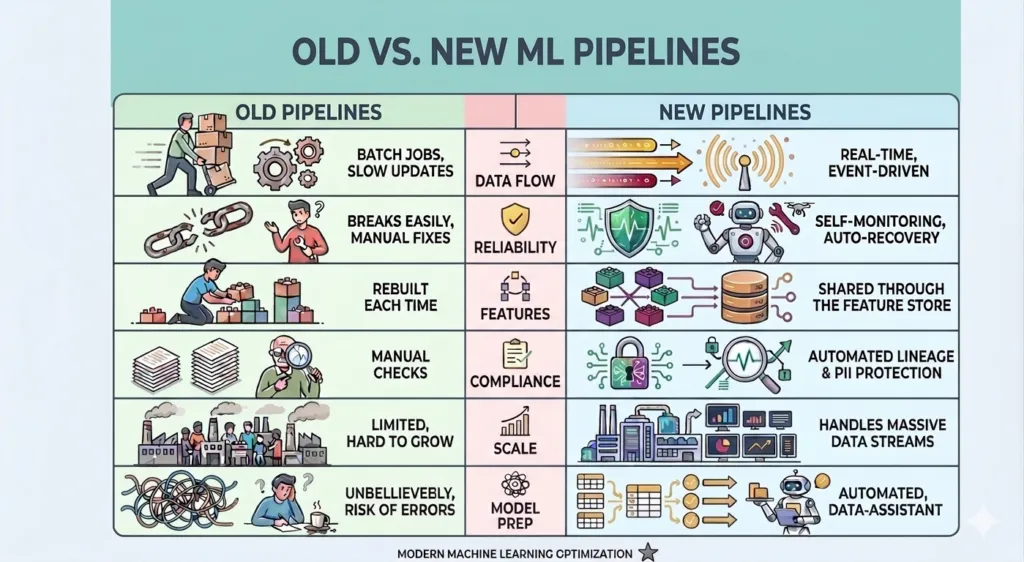
Comparison: Old vs. New ML Pipelines
Aspect
Old Pipelines
New Pipelines
Data Flow
Batch jobs, slow updates
Real‑time, event‑driven
Reliability
Breaks easily, manual fixes
Self‑monitoring, auto‑recovery
Features
Rebuilt each time
Shared through the feature store
Compliance
Manual checks
Automated lineage and PII protection
Scale
Limited, hard to grow
Handles massive data streams
Model Prep
Manual splits, risk of errors
Automated, leakage‑free
The 2026 Machine Learning Data Pipeline Stages
Machine learning data pipelines are modular, event-driven, and built to handle whatever challenges come their way: more data, more rules, more complexity. Every stage matters, turning messy, raw data into clear, model-ready features.
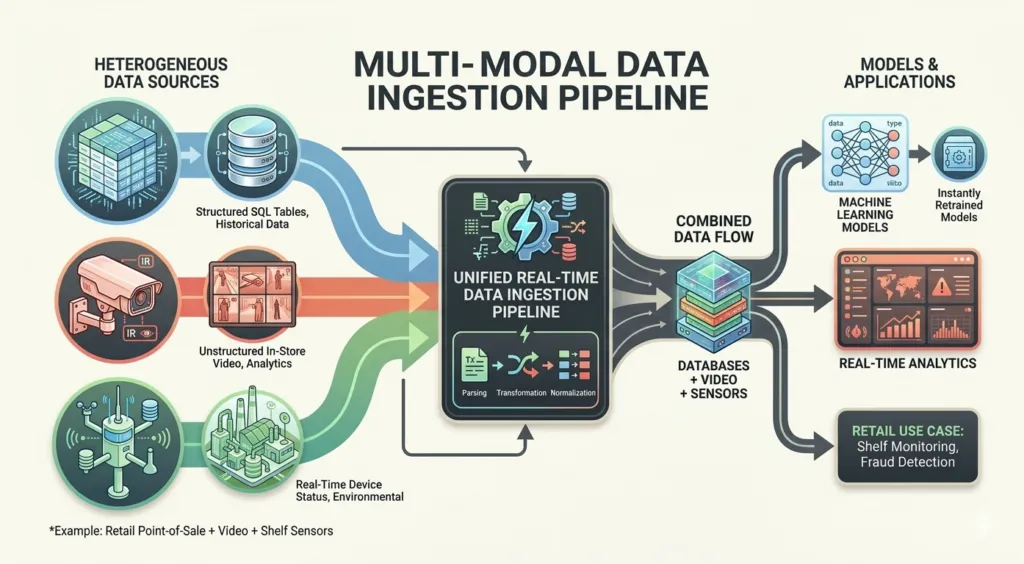
❶ Multi‑Modal Ingestion
Data is not simple anymore. Teams manage SQL tables, video clips, and IoT signals all at once. The old pipelines? They just could not keep up. The new ones support real-time data ingestion****, which means they collect everything – live and in sync. No more waiting hours for data to slowly arrive. Models get the latest info right away.
Example: Consider a retail chain. They are pulling transactions from cash registers, video from security cameras, and shelf sensor readings – all feeding into a single pipeline, live.
❷ Automated Cleaning & Validation
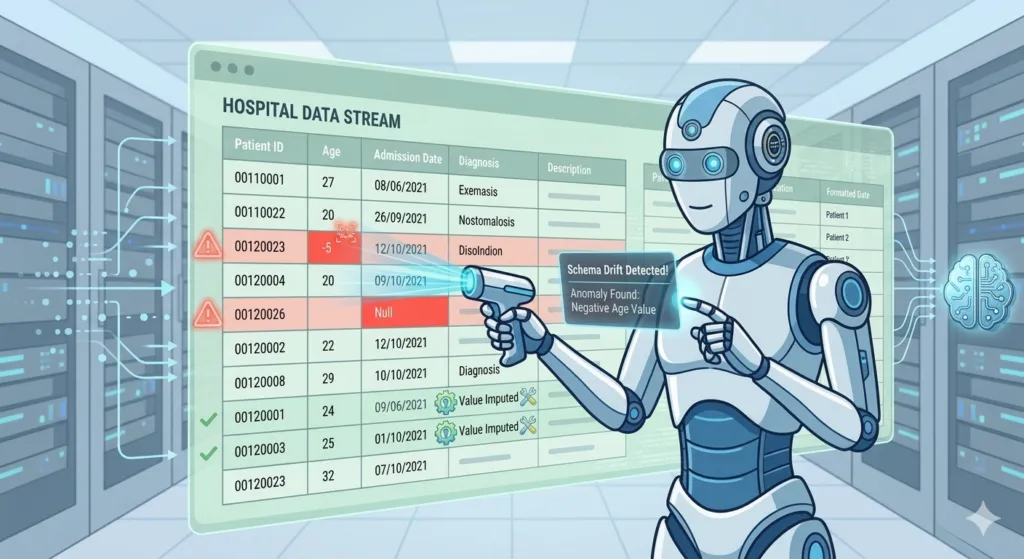
Raw data is always a mess. Missing fields, odd formats, and random outliers cause problems. Data Quality Bots now take care of them. Before delivering the data to the model, they review it, fix any errors, add any missing information, and flag any issues.
Example: A hospital can find records missing important details. The system either fills those gaps or marks them for human review, so the records that reach the model are the ones worth training on.
❸ Feature Engineering at Scale
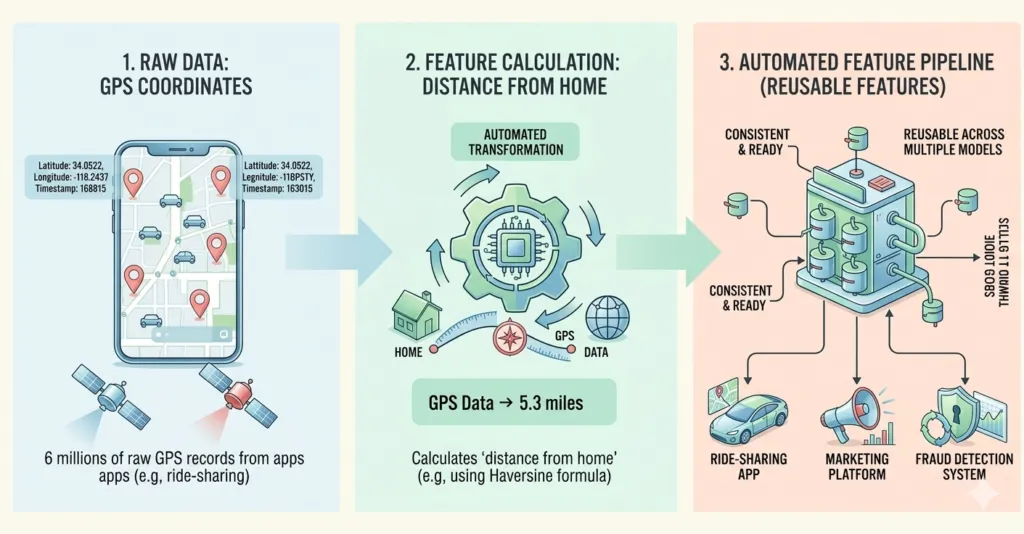
This is where the magic happens. Raw data turns into usable signals. Instead of providing raw GPS coordinates to a model, it calculates “distance from home.” In 2026, feature engineering pipelines do this automatically, across millions of records, so features stay consistent and ready to use.
Example: A ride‑sharing app uses GPS data to generate metrics such as “average trip distance” and “minutes stuck in traffic.” Those features enable every single ride.
❹ The Feature Store
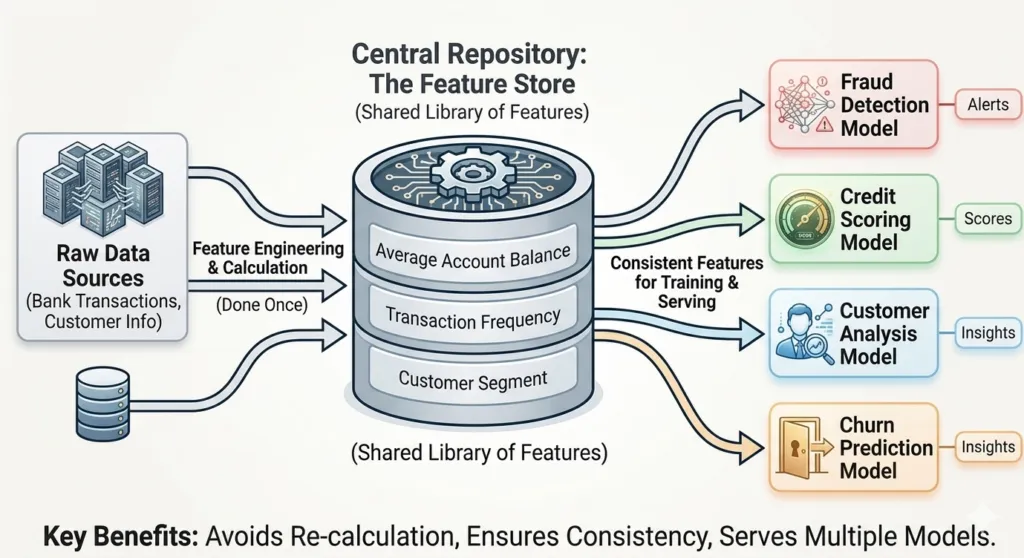
Here’s where teams get smart about their work. A feature store is a shared library- a place to put all those carefully built features so you only build them once. No more wasting time recalculating. No more inconsistencies.
Example: Consider a bank. They store features like “average account balance” and “transaction frequency,” then use them everywhere: fraud detection, credit scoring, customer analysis. It is a central spot that provides data to many models.
❺ Model Readiness
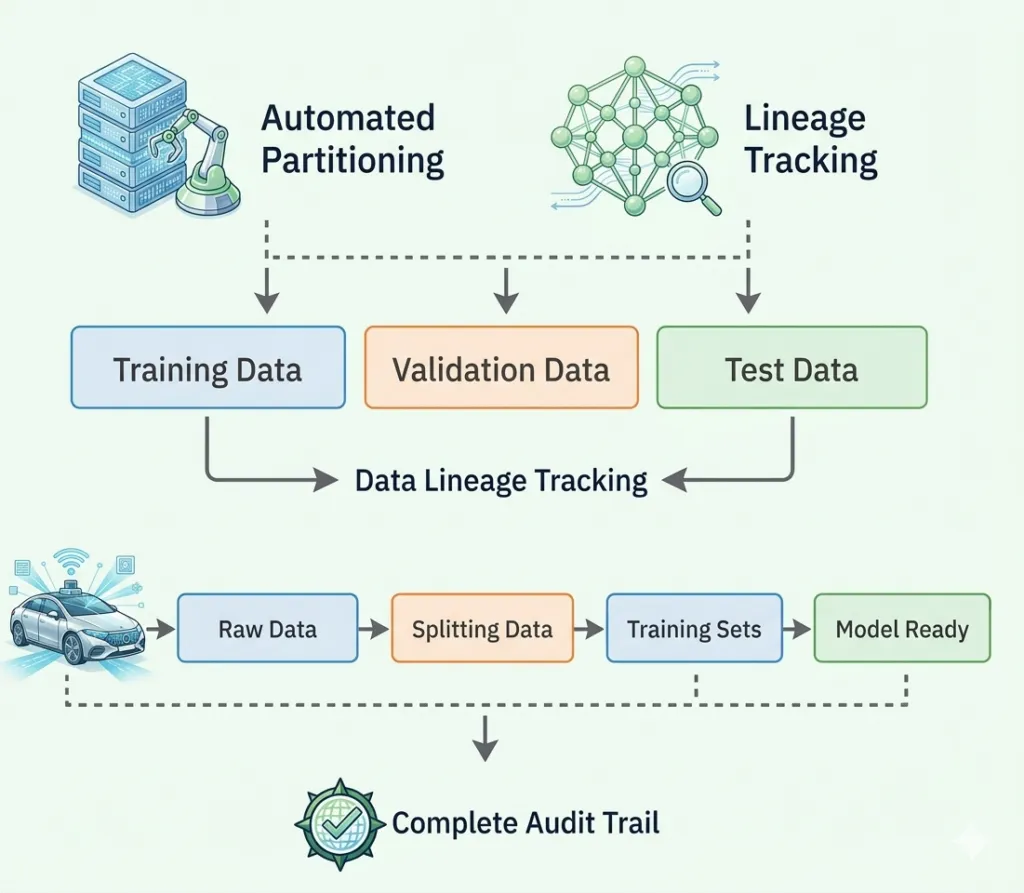
Before teams train a model, the data needs to be split into training, validation, and test sets. Doing that manually? Risky. Teams end up with bad splits or leaks. The new pipelines ensure model data readiness by handling splits automatically and tracking every step, so teams always know how their data is prepared.
Example: Consider an autonomous vehicle company. They ensure sensor data is cleanly split so the training set never overlaps with the test set. The whole process is tracked and transparent.
Putting It All Together
These stages are the backbone of modern machine learning pipelines. They turn raw, chaotic data into clean, model-ready features – fast, reliable, and clear. In 2026, there is no room for mistakes here. Nail this, and teams lead in AI.
Strategic Choice: ETL vs. ELT in Machine Learning
Feature
ETL (Extract, Transform, Load)
ELT (Extract, Load, Transform)
Data Preservation
Discards raw data
Keeps raw data in a Lakehouse
Speed to Training
Slower
Faster
Compliance
Masks PII early
Masks PII after loading
Flexibility
Rigid
High
Scalability
Limited
Scales with cloud compute/storage
Cost Efficiency
Higher upfront cost
Lower, pay‑as‑you‑go
Complexity
Complex pipelines are harder to adapt
Simpler, modular, easier to extend
Error Handling
Errors caught before load
Errors handled after load
Use Case Fit
Best for compliance
Best for experimentation/speed
Resource Usage
Heavy on ETL servers
Use cloud resources
Maintenance
Manual updates
Easier with cloud tools
Data Freshness
Delayed
Near real-time
Integration
Works with legacy systems
Works best with a modern cloud stack
Analytics Readiness
Pre-shaped for BI tools
Raw data available for ML + BI
➜ Quick Take: People use ETL when strict rules, old systems, or early data masking matter—like in banks or hospitals. But when speed and scaling up matter more, and keeping the original data is key, ELT wins out. That’s what you see with tech firms, online shops, and AI startups.
Looking ahead to 2026, most machine learning teams are moving to ELT. Cloud lakehouses make it much easier to store raw data and test new ideas quickly.
The Rise of Real‑Time & Event‑Driven Pipelines
Batch processing used to rule the world of data. Now? If teams are still waiting all night for numbers to refresh, they are already behind. The “death of batch” is not just a buzzword- it is happening. Companies that stick with slow, overnight updates miss out on real moments that actually matter.
Today’s machine learning data pipelines work in real time. Every click, every sensor reading, every transaction– captured instantly, as it happens. Tools like Kafka and AWS Glue make all this possible. Data does not wait around for a scheduled batch; it just keeps flowing. And if something shows up late or out of order, backfill tools jump in and fix it automatically. Teams do not lose hours fixing broken records, and models carry on without interruption, even when streams become disorganized.
The difference across industries:
- Retail: Recommendations shift as people shop, not hours later.
- Healthcare: Patient monitors flag issues in seconds, before it is too late.
- Finance: Fraud detection acts right when something’s off.
- Logistics: Supply chains adjust in real time to address delays or sudden spikes in demand.
Data Engineering for ML: The Privacy‑First Era
-→ Synthetic Data Generation
Machine learning runs on data, but using real customer info is risky. That is where synthetic data comes in. Generative AI lets teams build artificial datasets that replicate real-life patterns, without ever accessing anyone’s private info. Companies can train, test, and share their models while remaining compliant with privacy laws such as the GDPR.
Consider hospitals: they can create fake patient records for research and keep real identities totally hidden.
-→ Automated Data Lineage
The more complicated data pipelines get, the harder it is to keep track of what is happening. Teams do not just need to know what data they have– they need to know where it came from and how it changed along the way. Automated data lineage tools take care of this by tracking every step, from the moment data comes in through all the transformations it experiences. That is a major development in the field of explainable AI. Regulators and auditors now expect clear evidence of how every decision is made.
Banks use lineage to show exactly how transaction data feeds into their fraud models. Tech companies use it to spot errors fast. Either way, lineage makes AI systems more transparent and much easier to trust.
-→ PII Redaction
Personal data needs protection at every stage. As data moves across the system, PII redaction techniques eliminate names, addresses, and IDs. They filter data in transit, so only the right content reaches the models. Because regulations operate automatically in the background, there will be fewer leaks and less work for compliance teams.
In healthcare, patterns in patient data can be identified without compromising patient identities. In retail, teams can dig into shopping habits without ever seeing a customer’s name.
Closing Note
Synthetic data, automated lineage, and PII redaction are not just nice-to-haves– they are the backbone of privacy-first machine learning. With these tools, organizations can move fast and innovate, all while proving that strong privacy is not a roadblock. It is what makes trustworthy AI possible.
Why Flexiana’s Functional Approach Wins at Data Engineering
✔️ Clojure for Immutable Transformations
Flexiana builds its data engineering for ML pipelines with Clojure, a language that treats data as unchangeable. Once the data appears, it does not change. This means every transformation is predictable and easier to debug. When teams are building feature engineering pipelines, they want to be reliable —their models depend on consistent inputs to keep performing well.
✔️ Metrics: Data Freshness and Pipeline Uptime
Flexiana does not just talk about reliability—we track it. We watch two things closely: how quickly new data reaches models (data freshness) and how often the pipelines stay up and running (uptime). Put together, these numbers prove that the machine learning data pipelines are quick and extremely reliable. Models are trained on the latest data, and with real-time data ingestion, we ensure the models’ data is ready for production.
✔️ Tracking Data from Start to Finish
Flexiana adds automated data lineage to its pipelines. Businesses get a clear trail from entry to transformation. It makes model results easy to explain, audits easier to pass, and problems easier to solve. For regulated industries, this kind of transparency ensures that data engineering for ML is more than just a luxury—it is critical.
Closing Note
Flexiana’s functional approach blends immutable design, proven reliability, huge scalability, and clear lineage tracking. If your organization depends on real-time data ingestion, feature-engineering pipelines, and model data readiness, Flexiana’s machine-learning data pipelines deliver.
FAQs on Machine Learning Data Pipelines
Q1: What is the most time‑consuming part of a pipeline?
Data preparation, without a doubt. Teams spend most of their hours—sometimes 60 to 80 percent—just cleaning, labelling, and formatting data before even thinking about models. Skip this, and even the best machine learning data pipelines won’t give you good results.
Q2: What is a Feature Store?
Consider it a library of features that you have already developed. Teams can save a ton of time and ensure consistency by reusing features across many models. A retailer, for example, can save “customer purchase frequency” and use it for both recommendations and churn predictions.
Q3: Should we build or buy pipeline tools?
Most teams mix it up. For things like scale and dependability, they purchase tools from vendors after developing custom solutions that make them special. It is a technique to maintain flexibility while controlling expenses.
Q4: What is real‑time data ingestion****?
It is about pulling in data immediately upon creation. Banks use it to catch fraud on the spot. Online stores update recommendations as you shop. In today’s machine learning world, real‑time data ingestion is a must.
Q5: Why is automated data lineage important?
It shows you exactly how data moves through your pipeline, from start to finish. This makes it way easier to explain model results, meet compliance, or find out where something went wrong. In healthcare, for instance, automated data lineage proves patient data was handled correctly.
Q6: What does model data readiness mean?
It means your data is clean, up to date, and formatted so that models can use it immediately. If you do not have this, expect mistakes or delays. In finance, model data readiness lets trading algorithms react to the latest market moves instantly.
Q7: How do feature engineering pipelines help ML?
Feature engineering pipelines turn messy, raw data into something your models can actually work with. Let’s say you have a collection of “transaction history”—rather than inserting it unchanged, you break it down into something cleaner, like “average spend per month.” Stuff like that makes a real difference. These pipelines extract the right details, so your models perform better and are not confused by junk or bias embedded in the data.
Q8: What metrics matter most in Machine Learning data pipelines****?
Two things really stand out: how fresh the data is, and how regularly the pipeline stays active. Freshness tells you whether your data is up to date, and uptime shows how reliable your pipeline is. Both matter if you want to make real-time decisions.
Q9: How do ML pipelines scale to enterprise workloads?
They move serious data—consider 100GB each second. That is how retailers or hospitals crunch billions of records quickly, keeping real‑time analytics and large-scale feature-engineering pipelines running smoothly.
Summing Up
Machine learning models get the spotlight, but the real impact lies upstream. Most of what decides whether the system works comes from how well data is prepared, cleaned, and delivered. Strong data pipelines directly translate into more accurate, reliable, and efficient systems.
That is where Flexiana’s approach comes in. Our functional style means data stays predictable because transformations do not mess with the originals. Tracking things like data freshness and pipeline uptime shows if everything is on track. We design pipelines to handle big workloads without breaking down. And with automated data lineage, teams always know where their data has been. Put it all together, and teams get pipelines they can actually trust.
See the difference everywhere. Banks need real-time data to spot fraud as it happens. Hospitals have to track every data step to meet regulations. Retailers want to build smart recommendations, so they lean on feature engineering. In every case, strong pipelines lead to better models.
Whenever pipelines fail to deliver, everything stops moving. But when they work, teams can trust their data, handle whatever comes their way, and get insights right when they need them.
From ingestion to training, building robust data pipelines is complex. Reach out to Flexiana to get it right from day one.
Tagged