
AI & machine learning
MLOps in 2026: What Is It and Why Should You Care?
Jiri Knesl 13 min read
MLOps is the operational framework that ensures machine learning models are built, deployed, and run efficiently at scale.

Table of Contents
- 🔷 The Definition
- 🔷 The Three Pillars of MLOps
- 🔷 Eliminating “Model Drift.”
- 🔷 Accelerating Time-to-Market
- 🔷 Ensuring Regulatory Compliance
- 🔷 Orchestration Platforms
- 🔷 Data Versioning
- 🔷 Containerization & Infrastructure
- 🔷 The Clojure Advantage
- 🔷 Key Metrics MLOps Enables
- 🔷 Business ROI Metrics
- 🔷 Key Evaluation Criteria
- Q1: Is MLOps just DevOps for AI?
- Q2: When should we start thinking about MLOps?
- Q3: Does MLOps help with AI security?
The development of AI software is progressing rapidly. Many organizations now work with a Machine learning development company to turn early ML ideas into Scalable software solutions.
Machine learning can be viewed as the core engine, while MLOps serves as the operational framework that ensures the engine is built, deployed, and runs efficiently at scale.
By 2026, building a machine learning model will no longer be the primary challenge. The real effort begins after development, ensuring the model remains accurate, operates reliably in production, and remains cost-effective over time. While many teams are accelerating AI adoption, a significant number of models fail to reach production, and others degrade in performance after deployment
When there is no clear process, a few common problems show up:
- Model drift. Predictions slowly become less accurate.
- Data inconsistencies. Training data and live data don’t match.
- Compliance risks. It’s possible to handle sensitive data improperly.
- Poor monitoring. Until people complain, teams are unaware of problems.
This is why MLOps now sits at the center of modern AI software development. It helps teams move from experiments to reliable systems that fit into Full-cycle software development.
With a well-established MLOps framework, teams are able to:
- Deploy models faster
- Keep models accurate over time
- Build scalable software solutions for real products
- Improve engineering productivity measurement with clear metrics and automation
And for organizations working with a Machine learning development company, MLOps turns machine learning into a real capability.
In this guide, we will explore how MLOps works. We will also see why it matters in 2026. And how teams use it to build secure Privacy-first AI software development pipelines that run in production.
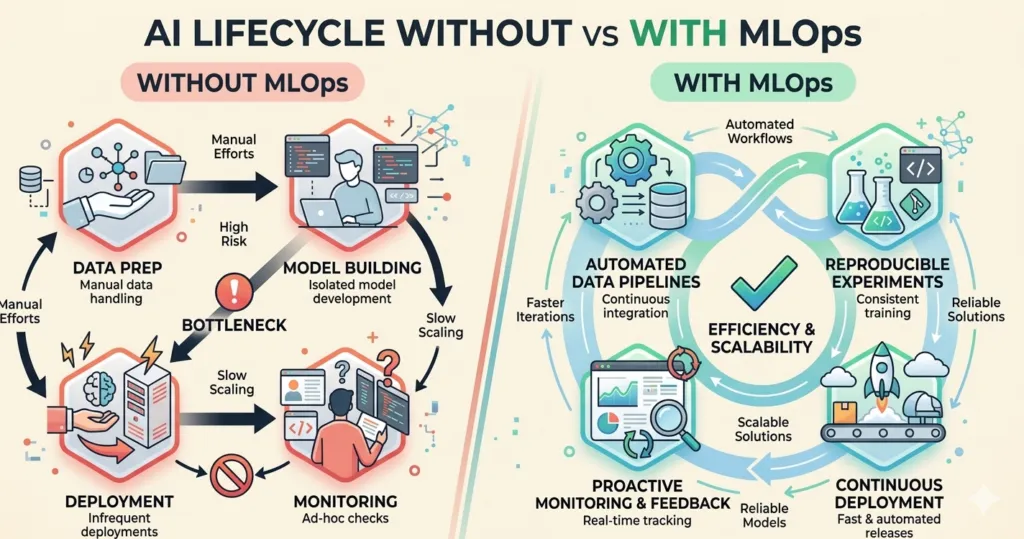
So, What is MLOps All About? Defining the Intersection of AI and DevOps
🔷 The Definition
Basically, it’s short for Machine Learning Operations (MLOps).
Let’s think of it as the practical side of machine learning—the step where models leave a data scientist’s notebook and move into the real world. Teams can experiment with models endlessly, but they only matter when they’re running inside an actual product. Out there, they need to be accurate, manage up-to-date data, and keep working without falling apart.
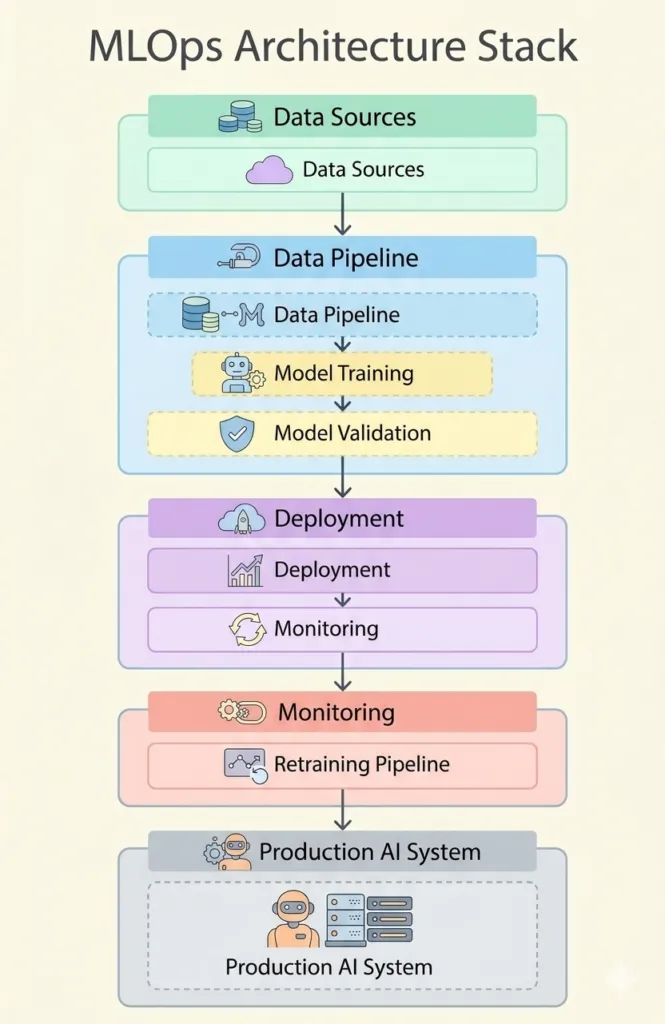
MLOps provides the framework that enables this to happen by bringing together a range of interconnected functions, including:
- DevOps, which takes care of automating deployment and keeping the infrastructure operational
- Data engineering, which organizes and prepares data
- Machine learning engineering, focused on building and improving the models themselves
- Software operations that watch over all components after deployment.
🔷 The Three Pillars of MLOps
MLOps primarily consists of three components: data, models, and operations. They all depend on each other.
❶ Data Engineering
Machine learning depends entirely on its data. If the data pipeline breaks, the model fails. Data engineering handles everything—from retrieving data from various sources, checking for missing or anomalous values, monitoring dataset changes, and turning raw numbers into something models can work with.
So, what enables all of this to run smoothly and reliably?
- Apache Airflow to schedule
- DVC to track datasets
- Snowflake to store data in the cloud
- Apache Spark to process large datasets
These tools make the whole process more reliable and way less messy.
❷ Model Engineering
The emphasis here is on developing and refining the models themselves.
- Teams spend time training on past data
- Improve hyperparameters to achieve good results
- Track what experiments they have tried so they don’t lose track
- Save models so they can roll back or reuse them as needed
Teams rely on tools such as MLflow, Weights & Biases, and TensorFlow Extended (TFX) to manage complexity and avoid infinite loops.
❸ Operations
After teams finish training a model, the real challenge begins: putting it to work and keeping it on track.
- Teams need a robust CI/CD pipeline to ensure updates and fixes are deployed without issues.
- Teams must monitor the situation—make sure the model’s doing its job.
- Models can drift off course if conditions shift, so teams need to detect them and retrain them automatically.
- When more users show up, teams must scale up quickly.
If any of these aspects are overlooked, models can quickly become unreliable, degrade in performance, or fall out of use altogether.
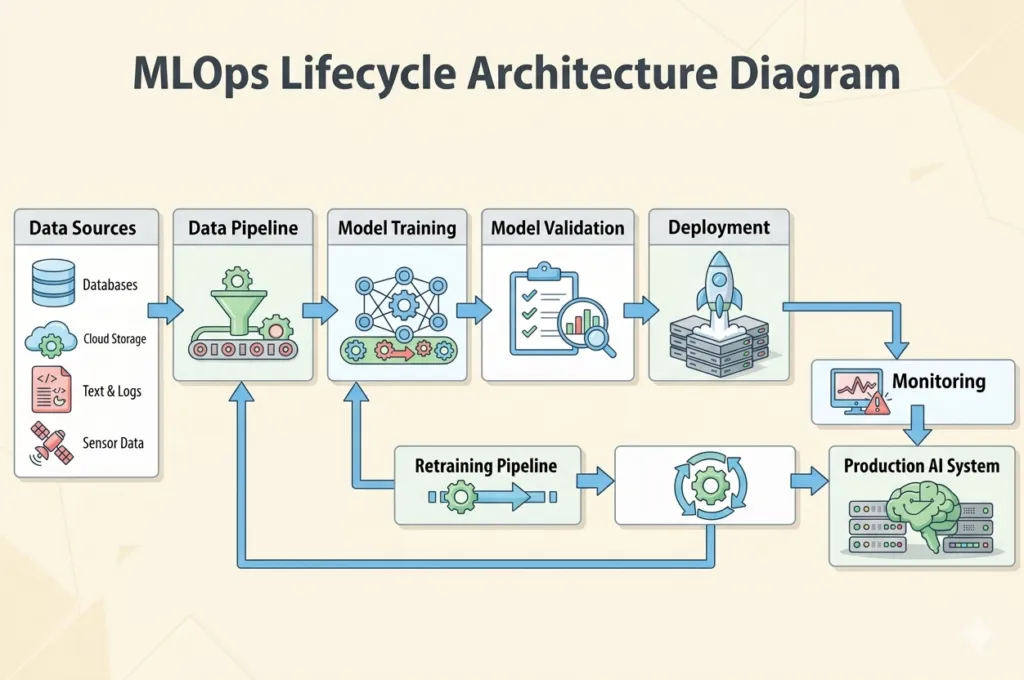
Why MLOps Is Non-Negotiable for Modern Busines
🔷 Eliminating “Model Drift.”
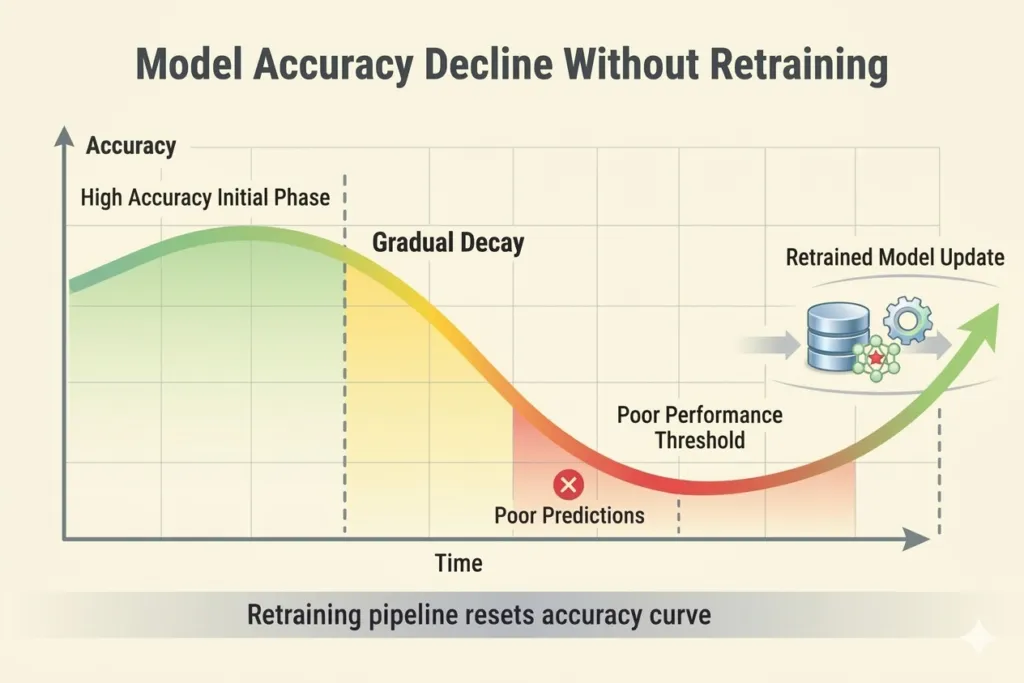
Machine learning models do not remain accurate indefinitely. As markets evolve, user behavior shifts, and real-world conditions change, the data used to train models gradually becomes outdated. When this happens, model performance declines—a phenomenon known as model drift.
This drop starts quietly, hard to see at first.
- Accuracy drops over time.
- Predictions become increasingly inconsistent.
It looks normal outside, but inside, teams work without proper insights.
MLOps addresses this challenge by introducing continuous oversight and automation. With MLOps in place:
- Model performance is monitored in real time.
- Data drift is detected as soon as deviations occur.
- Retraining starts without manual effort.
As a result, models keep adapting to current data and remain aligned with real-world conditions rather than outdated patterns.
🔷 Accelerating Time-to-Market
When teams follow the traditional machine learning process, progress is slow.
- Data scientists create and test models within their own environment.
- Then, engineers step in, rework all the code to fit the real world, and ultimately deploy it.
- Sometimes, that exchange goes on endlessly for weeks—sometimes months.
It’s frustrating and delays any real impact.
MLOps flips that script. With clear, repeatable pipelines, models effortlessly move from testing to production. Automated tests keep things on track and consistent, and CI/CD tools let the team push out updates quickly—sometimes even daily.
Suddenly, everyone can experiment, tweak, and deploy very quickly. Teams get results much faster, and the company notices the difference.
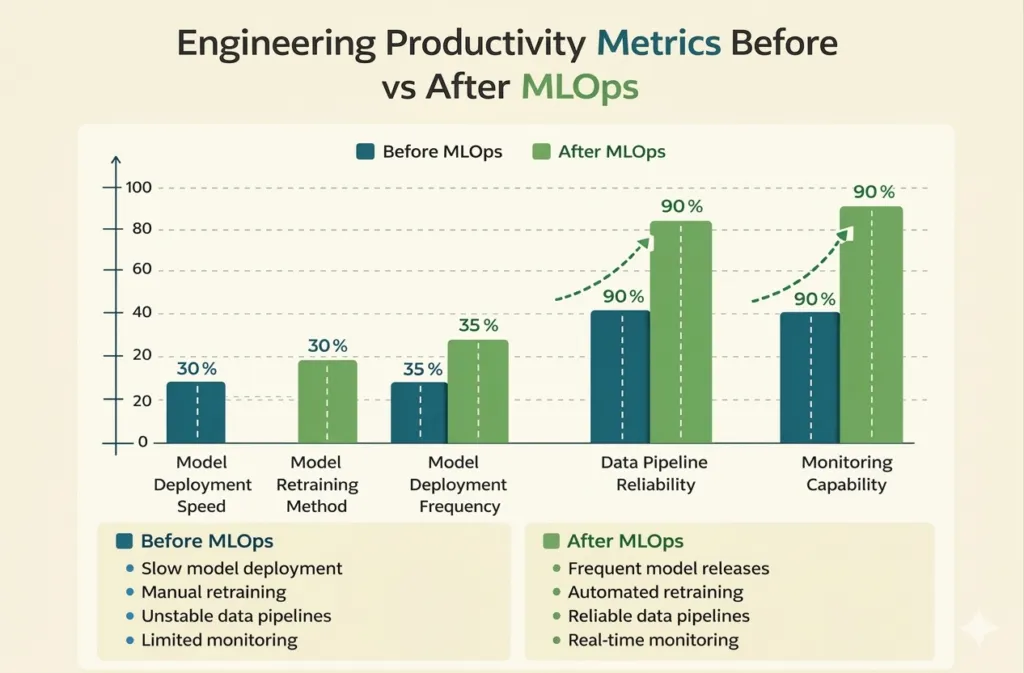
🔗 Google Cloud research shows that companies using MLOps deploy machine learning models about 30% faster because much of the process is automated.
🔷 Ensuring Regulatory Compliance
If a team is in finance, healthcare, insurance (or any regulated sector), they cannot overlook compliance requirements such as GDPR, HIPAA, or SOC 2. As new AI laws emerge, restrictions continue to increase. Without solid processes, staying transparent and accountable gets messy. It’s tough to explain why the model made a decision or to prove exactly where the data came from.
That’s where MLOps shines. Teams get audit trails for every model change—nothing is missed. It’s easy to see all the data sources and transformations, and the workflow stays completely traceable. That’s not just nice to have anymore—it’s essential if teams want to stay in business and out of trouble.
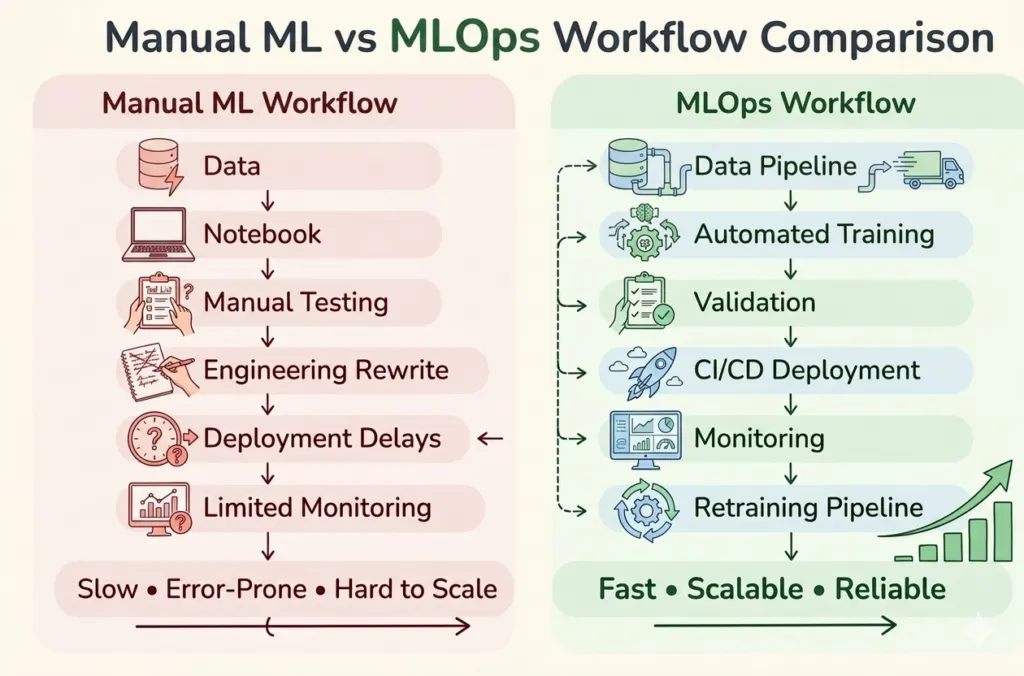
Comparison: Manual ML vs Automated MLOps
Consider this: A team is building ML systems the old way, solely through manual effort. Each team controls individual components, tools don’t work together, and no one’s really sure who did what—or when. Deployments are delayed, and each update causes problems. MLOps changes everything.
Teams automate the entire pipeline, standardize best practices, track every version, and monitor the system from start to finish. Everything just works better—and a lot faster.
Here’s how they compare.
Feature
Manual ML Workflow
Automated MLOps
Deployment Speed
It will take days, sometimes weeks.
Achieved within minutes.
Monitoring
Teams only find problems once something fails.
Stay ahead—automated alerts let teams know before issues arise.
Scalability
Pretty tough to replicate across teams.
Makes it easy to implement standardized solutions at scale.
Reproducibility
Depends on each person’s local setup, so results vary widely.
Versioned pipelines keep experiments and results consistent.
Security
Teams fix security flaws when they appear.
Privacy and compliance are part of the design from day one.
Collaboration
People work in silos, and it’s hard for others to see what’s going on.
Shared pipelines and experiment tracking let everyone stay in sync.
Model Versioning
Often gets skipped or done manually.
Automatically tracks every model version.
Data Versioning
It’s hard to know how your data is changing.
Every dataset version is logged and recorded.
Testing
Mostly manual and tedious.
Validation and testing run automatically.
Deployment Process
Engineers need to rewrite a lot of code just to deploy.
CI/CD pipelines handle deployment for the team.
Model Updates
Retraining happens when someone notices a problem.
Set up scheduled or trigger-based retraining—no need to wait for failure.
Failure Recovery
Teams only address issues after production failures.
Continuous monitoring catches problems early.
Experiment Tracking
Results are scattered or easily lost on local machines.
All experiments are tracked, easily compared, and fully reproducible.
Manual workflows make it seem like teams have to start over every time. MLOps makes the process easy to repeat. Models move from training to production through a defined pipeline. Teams know what changed. They know what version is running. And they can update models without breaking the system.
The MLOps Tech Stack in 2026
🔷 Orchestration Platforms
Machine learning pipelines aren’t simple. Teams have data preparation, model training, validation, and deployment—all of it has to happen in the right order. Orchestration tools make sure that happens. Common tools include:
- Kubeflow
- MLflow
- Apache Airflow
These manage training pipelines, automate tedious tasks, and handle deployments. So instead of running around, clicking buttons, and hoping teams didn’t skip a step, they let the pipelines do the work—and avoid those silly mistakes.
🔷 Data Versioning
Data never remains static. New items arrive, old items get tweaked, sometimes things just disappear. If teams don’t keep track, their models turn into a mess. Data versioning tools keep everything organized. The tools are
- DVC (Data Version Control)
- LakeFS
- Delta Lake
Teams can roll back to earlier datasets, repeat old experiments, and work with other teams without causing conflicts. When someone asks, “Which data did we use for this model?” teams actually have an answer.
🔷 Containerization & Infrastructure
Teams can’t trust code to work the same everywhere, considering all the unusual quirks in different systems. That’s where containers help. Most ML teams use
- Docker containers
- Kubernetes clusters
- Serverless ML setups
Containers bundle the model, code, and everything else it needs. So teams know it’ll work—locally, on the cloud, wherever. That means fewer surprises and smoother scaling.
🔷 The Clojure Advantage
Some teams include Clojure in the AI systems. It runs on the JVM, so teams get access to the massive Java ecosystem. What’s cool about Clojure?
- The platform is stable
- Immutable data structures help kill off annoying bugs
- It handles concurrency like a champ
For large systems that process large volumes of data or run multiple jobs concurrently, Clojure is a perfect fit. In some enterprise setups, it integrates seamlessly with those MLOps pipelines and keeps things running smoothly.
Measuring ROI: Engineering Productivity in A
Many companies underestimate how expensive it is to maintain AI systems—especially when building the model. That’s just the starting line. Most of the heavy lifting comes after the updates, the fixes when data pipelines break, and the constant monitoring. The real costs become apparent once the system is operational under real-world conditions.
This condition is known as hidden technical debt in Machine Learning Systems. The model continues to work, but behind the scenes, things become more complex and harder to maintain. That’s where MLOps steps in. It provides teams with a framework for launching models, tracking their progress, and retraining as needed. Even better, it makes it way easier to see how AI is actually doing.
🔷 Key Metrics MLOps Enables
When teams use MLOps, they get real numbers to track. These metrics show how quickly engineers can upgrade models or fix issues. Some of the main things teams watch:
- Time to retrain—how long does it take to refresh a model with new data
- Model deployment frequency—how often new models go live
- Prediction latency—how fast teams get answers from the system
- Data pipeline reliability—how much of the time everything operates correctly
These engineering productivity metrics help teams identify bottlenecks that slow progress. They’re also a solid way to boost productivity across your AI projects.
🔷 Business ROI Metrics
Sure, engineering metrics matter, but they don’t tell the whole story. Businesses ultimately want to see the results of their investment. Thus, they consider things such as:
- How many machine learning features increase revenue
- Whether more customers are converting
- How much they’re saving by cutting operational costs
These are the numbers that connect the AI system to actual business value. If a model brings in more sales or saves people from boring manual work, that’s when the payoff gets real. That’s the true return companies look for when they invest in MLOps.
How to Choose a Partner for Your AI Infrastructure
🔷 Key Evaluation Criteria
Pay close attention to how they handle building and maintaining those systems. Lots of AI projects fail because someone builds a model and then abandons it. The best partners stick around for the entire journey.
Checklist
✔️ Automated model testing: Just like regular software, AI models need to be tested regularly. Automated tests make it way easier to spot accuracy issues or catch errors early. Plus, they let teams know if the model starts behaving strangely because new data is skewing its predictions.
✔️ CI/CD pipelines for ML: Models aren’t static. They change as new data arrives. Improvements are made. A good team builds CI/CD pipelines so models can be updated and deployed safely.
✔️ Continuous monitoring: The work is not finished once the modes go live. Teams have to monitor performance once they’re running in production. Monitoring helps teams spot drops in accuracy or unusual behavior.
✔️ Data governance systems: AI systems depend on data. Teams also need solid rules for data—where they store it, who gets access, and how they keep it private. Good governance keeps both the company and users safe.
✔️ Documentation and reproducibility: If an AI system is unclear or cannot be reproduced, it creates problems for teams. When teams document things clearly, it’s way easier to rebuild models, solve problems, or continue developing later.
Common Questions (FAQs)❓
Q1: Is MLOps just DevOps for AI?
Not really. MLOps and DevOps share some practices. Both use automation and continuous deployment. But MLOps deals with more pieces.
DevOps mostly manages code. MLOps manages code, data, and models. And those pieces change over time. Data shifts. Models lose accuracy. Without updates, predictions decline—ML systems require ongoing checks and retraining.
Q2: When should we start thinking about MLOps?
Right from the start. MLOps should be part of the first version of your AI software. Not something you try to add later. Without structure, ML projects get messy fast. Models become hard to track. Data pipelines break. Updates become risky.
And fixing that later usually costs more than building it properly from the beginning.
Q3: Does MLOps help with AI security?
Yes. MLOps pipelines add layers like security checks and automated scans, not always found in standard DevOps. They also control how data moves through the system. This makes it easier to see where training data comes from and who has access to it.
And it helps prevent unsafe or unverified data from being used to train models.
Conclusion
Business value cannot be created by machine learning alone. What matters is how it works in real systems.
Many teams build models that perform well in tests. But without the right setup around them, those models stay in notebooks or demo apps. They never become part of a real product. This is where MLOps matters.
MLOps helps move a model from prototype to production. It puts structure around how models are trained, deployed, and updated. Data changes. Models lose accuracy. Systems need updates. MLOps helps teams manage all of that. Companies that invest in a few key areas tend to move faster:
- AI software development
- Engineering productivity measurement
- Privacy-first AI development
These practices make AI systems easier to build and maintain. And they help teams keep systems running as data and products change. Over time, that leads to a real advantage.
MLOps isn’t optional anymore, and if you want to get it right, the team at Flexiana is a great place to start the conversation.
Tagged