
AI & machine learning
How to Get Started with Machine Learning (2026 Implementation Guide)
Jiri Knesl 16 min read
A comprehensive guide to implementing machine learning in 2026, covering the 5-step roadmap from problem definition through scaling.
Table of Contents
Moving from data collection to actual AI software development and machine learning implementation is no longer just a nice-to-have; it is how to stay in business.
In 2026, if businesses invest in AI development services or partner with a reputable machine learning development company, they can finally turn all that raw data into AI-powered business intelligence (BI). And that actually works.
If businesses wait, they are already behind. The competitors are busy automating their workflows, personalizing their interactions with customers, and growing faster thanks to machine learning. This guide walks through how to get started with ML in 2026 and highlights common mistakes that confuse most newcomers.
So why step in now? Three things make 2026 the year everything shifts for AI:
- Mature ecosystems: Tools are ready to use. Platforms like AWS SageMaker, Google Vertex AI, and new options for private deployments make machine learning more accessible than ever.
- Regulatory clarity: The rules are now clear. GDPR, CCPA, and the new AI Act lay out exactly how to use AI responsibly.
- Competitive necessity: Third, the pressure is on. Whether it is predicting customer churn or automating paperwork, Machine learning has moved beyond trials. It is just the way business operates now.
The 5-Step Roadmap to AI Integration
Learning to use AI effectively is best approached as a journey rather than a single step. Organizations can follow five clear stages that build on one another: defining the problem, preparing the data, selecting the appropriate model, testing through a pilot, and finally scaling the solution thoughtfully and responsibly. Each stage plays a critical role. By progressing methodically, teams can avoid costly mistakes while giving their AI initiatives a strong foundation for long-term success.
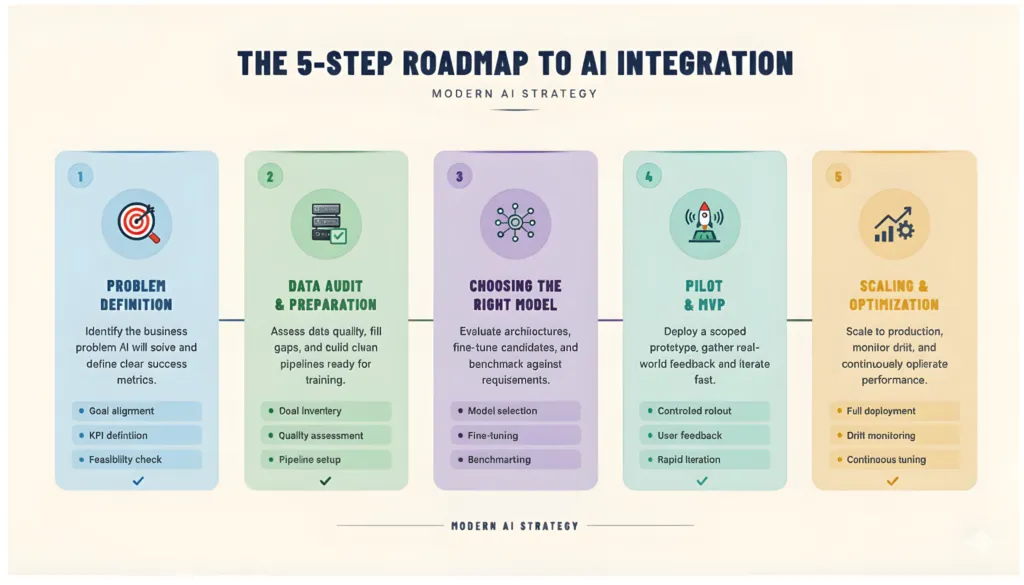
Step ❶: Problem Definition
Start by figuring out where AI can actually help. The best projects begin with a real business pain point and a measurable goal. Do not waste time on unclear ideas- focus on a specific goal.
Some typical examples?
- Churn prediction for subscription businesses.
- Automating legal or finance documents.
- Use of AI to detect fraud in banks.
These are practical cases with a clear impact. They don’t need huge datasets, complex systems, or long setup times. They work, and they show the company that AI is real.
👉 “McKinsey & Company estimates that AI and analytics could add $3.5 to $5.8 trillion in value each year across industries, showing the strong ROI of well‑planned machine learning.”
A good machine learning development company can identify the right starting point, help businesses secure that early win, and lay a foundation for greater achievements in AI software development.
Step ❷: Data Audit & Preparation
Strong models depend on strong data. Before businesses build anything, take a good look at what they have.
Key questions to consider include:
- Is the data fragmented across multiple systems? If so, efforts should be made to break down data silos and establish unified access.
- Are the data compatible, or have calculation methods changed over time?
- Can teams access the data while remaining fully compliant with security, privacy, and regulatory requirements?
- Is the data clean, structured, and consistent? This may require removing duplicates, standardizing formats, and addressing missing or incomplete values.
Structured data, such as CRM records, is typically easier to manage and analyze. However, organizations should not overlook unstructured data, including emails, PDFs, and images, which often contain valuable insights. This is where AI development services add significant value by organizing and transforming unstructured information into formats that can be effectively analyzed. Even the most advanced models cannot compensate for poor-quality data. Simply put, reliable and well-prepared data is essential for achieving meaningful AI outcomes.
Structured vs. Unstructured Data Readiness
Category
Structured Data
Unstructured Data
Format
Organized, labeled
Raw, messy, no fixed format
Examples
CRM records, transactions
Emails, PDFs, images, videos
Ease of Use
Ready for ML models
Needs cleaning and processing
Preparation
Minimal work
Heavy preprocessing required
Use Cases
Churn prediction, fraud detection
Sentiment analysis, document automation
Step ❸: Choosing the right model
- Not every problem requires the same AI approach. The key is selecting the method that best fits the use case.
- When labeled data is available, and the goal is to predict a specific outcome, such as identifying customers likely to churn, supervised learning is often the most effective choice. If labeled data is not available, unsupervised learning can help uncover hidden patterns, such as grouping customers with similar behaviors.
- For tasks involving large volumes of text, such as extracting key insights or summarizing contracts, large language models (LLMs) are particularly well-suited. Choosing the right approach ensures that AI solutions remain practical, efficient, and aligned with business objectives.
Step ❹: Pilot & MVP
Avoid deploying AI across the entire organization at once, as this can introduce unnecessary risk and complexity. Instead, begin with a minimum viable product (MVP) or a focused pilot to validate the approach and gather insights before scaling.
Start small. Test with real data. See how it performs, and gather feedback from the people who use it. That builds trust and helps convince skeptics. Privacy‑first AI software development should test in secure environments and safeguard sensitive data.
Step ❺: Scaling & Optimization
If the pilot proves successful, the next step is to scale it thoughtfully. However, AI systems cannot simply be deployed and left unattended—they require ongoing monitoring and maintenance. As business conditions and data evolve, models can drift and lose accuracy. Organizations should continuously evaluate model performance, retrain with updated data, and monitor for bias, security, or compliance concerns. When managed effectively, AI-powered business intelligence (BI) can significantly transform how organizations analyze data and make decisions.
Reports run on their own, dashboards update in real time, and decisions happen faster. AI is now at the center of operations.
Key Takeaway
Bringing AI into the business is not a one-shot deal. Start small, prove it works, and then scale up carefully. Every step a business takes cuts down risk and builds momentum. With the right AI software development and machine learning development company, AI goes from experiment to essential- and helps businesses grow in a way that is smart, safe, and aligned with the goals.
Build vs. Buy in Machine Learning
Category
Off‑the‑Shelf AI APIs
Custom AI Software Development
Data Privacy
High risk of leakage, Limited control over shared data
Privacy‑first, full control
Accuracy
Generic results
Tuned to your data
Cost
High per request, low upfront costs
Lower long‑term
Flexibility
Limited options
Full roadmap control
Integration
Quick plug‑and‑play
Tailored to existing systems
Scalability
May hit usage limits
Scales with your infrastructure
Support
Vendor‑dependent
In‑house expertise
Speed to Launch
Fast start
Longer build time
Ownership
No IP ownership
Full IP ownership
Customization
One‑size‑fits‑all
Designed for your needs
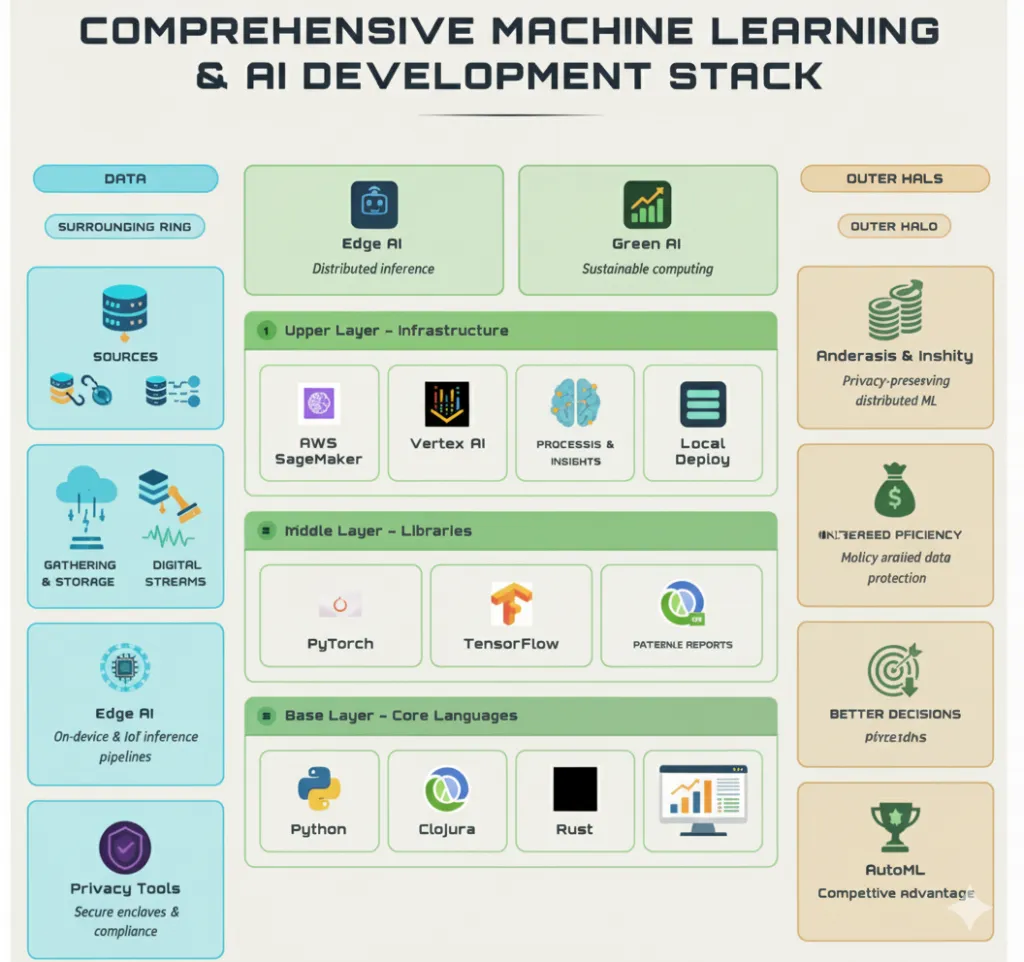
Essential Tools for AI Tech Stack in 2026
Core Languages
- Python → Preferred for research and quick experiments, thanks to its vast libraries and vibrant community.
- Clojure → It is gaining popularity in production thanks to its functional design, which boosts scalability and reliability.
- Rust → It gets involved when companies require a high level of speed. Particularly about the larger AI sectors, it maintains the speed and security of the operations.
- Julia → It is great if companies are very involved in math or scientific computing.
📌 Note: People really see Clojure as a solid choice for production machine learning.
Machine learning development company Flexiana uses Clojure for a reason- it helps them create systems that actually last.
-
Functional style → Since Clojure works with immutable data, businesses get fewer unexpected side effects, leading to fewer bugs creeping in. That is a big deal when businesses are running massive operations and need to trust their systems.
-
Concurrency → When it comes to handling lots of tasks at once, Clojure does the job well. It runs on the JVM, so it handles the heavy, parallel workloads businesses see in large machine learning pipelines.
-
Python interop → Flexiana runs production systems in Clojure but still trains models in Python. With libpython-clj, Python models can run directly inside Clojure. This way, teams get Python’s rich ML ecosystem plus Clojure’s stability- the best of both worlds.
-
Maintainability → Long‑term upkeep is easier with Clojure’s clean, composable design. Clojure’s clean, composable design makes that part a lot easier, especially when businesses are not just experimenting but actually running ML in production.
-
Ecosystem fit → Flexiana already has experience with Clojure. Keeping everything in the same language just makes their whole stack neater and more consistent.
Flexiana picks Clojure because it gives us control and reliability for real-world machine learning- without giving up the flexibility of Python when we need it. It is a solid balance between trying new things and keeping everything running smoothly.
Infrastructure
- AWS SageMaker → It covers everything- training, deploying, monitoring- all in one spot.
- Google Vertex AI → It organizes business datasets, pipelines, and deployed models.
- Azure ML → It is a go-to if the team is already using Microsoft tools.
- Privacy‑first local setups → On-prem or edge- help keep sensitive data protected.
- Hybrid models → They give businesses cloud power while letting them keep control where they need it.
- Containers & orchestration → Tools like Docker, Kubernetes, Serverless (AWS), and Serverless (Google Cloud) endpoints keep business models portable and simple to run.
Libraries
- Clojure → Users lean on scicloj.ml for building functional ML pipelines and also major Python libraries with libpython-clj.
- Python → PyTorch and TensorFlow are still the kings of deep learning.
- Specialized →For something more specialized, Hugging Face leads in NLP, RAPIDS focuses on GPU data science, and LangChain handles LLM workflows.
- Visualization → When businesses need to see their data, Plotly and Vega stand out, and now AI-powered dashboards are appearing too.
MLOps & Tooling
- Experiment tracking → To track experiments, MLflow and Weights & Biases get the job done.
- Monitoring → Evidently AI and Arize help businesses to keep an eye on their models.
- Version control → DVC and Git workflows manage both data and models.
- Pipeline automation → Automate business pipelines with Kubeflow and Airflow.
- CI/CD for AI → If businesses want to implement CI/CD, GitHub Actions and Jenkins (with ML plugins) maintain progress.
Security & Privacy
AI has become part of everyday business operations, making data protection more important than ever. Organizations cannot afford mistakes when it comes to sensitive information or regulatory compliance. Because of this, companies are placing much greater emphasis on security and privacy when developing AI systems. Several approaches are commonly used to achieve this.
- **Federated Learning:**Instead of sending all raw data to a central server, federated learning allows AI models to learn directly from data where it already exists. Only model updates are shared, not the actual data. This approach helps keep sensitive information private while still improving the model. It also supports compliance with privacy regulations such as GDPR and HIPAA.
- **Differential Privacy:**Differential privacy protects individuals by introducing small amounts of random noise into datasets during analysis. This allows teams to detect useful patterns and insights without exposing personal or identifiable information.
- **Zero-Trust Architecture:**Zero-trust security operates on the principle that no user or system is automatically trusted. Every request must be verified for identity and permission before access is granted. While strict, this model significantly reduces the risk of unauthorized access from both external threats and internal misuse.
- **Synthetic Data:**In many situations, real data cannot be shared due to privacy restrictions. Synthetic data provides a useful alternative. It is artificially generated but designed to mimic the patterns of real datasets. This allows teams to train AI models effectively without compromising anyone’s privacy.
- **Data Consistency and Calculation Drift:**AI systems can fail if the underlying data or calculations change unexpectedly. For example, modifying how metrics are measured or adjusting formulas can disrupt model predictions. Regular data audits help teams detect these issues early, ensuring that AI systems continue to perform reliably.
Emerging Trends Shaping AI Strategy
AI is evolving rapidly, and new technologies continue to influence how organizations design and deploy intelligent systems. Several important trends are currently shaping AI strategies.
- **Edge AI:**Instead of relying entirely on cloud infrastructure, some AI models now run directly on devices such as smartphones, smartwatches, or other edge devices. Processing data locally reduces latency, improves response time, and enhances privacy since data does not always need to leave the device.
- **Green AI:**Training large AI models can consume significant amounts of energy. Green AI focuses on improving efficiency by using smaller models, optimized computing techniques, and cleaner energy sources. The goal is to reduce environmental impact while also lowering operational costs.
- **AutoML (Automated Machine Learning):**AutoML tools automate many complex machine learning tasks, such as model selection and hyperparameter tuning. This allows organizations with limited AI expertise to build effective models quickly, making AI development more accessible.
- **AI Governance:**As AI systems become more widely used, proper oversight becomes essential. Organizations must be able to explain how their models make decisions and demonstrate that their systems operate fairly and responsibly. This involves maintaining audit trails, monitoring for bias, and clearly documenting models. Transparency is not only important for regulators but also for building trust with users and customers.
Addressing the Biggest Obstacle: Privacy & Compliance
Key Regulations to Know
- GDPR (EU): Strong data laws and severe fines for errors.
- CCPA (California): Demands clear privacy rights and transparency for consumers.
- Right to be Forgotten: People can ask to have their data erased, no questions asked.
- EU AI Act (2026): New rules will categorize AI systems by risk.
Privacy-First AI Software Development
- Start with privacy. Make compliance part of business AI from day one, not just an add-on later.
- Collect less data. Only grab what the business really needs- avoid stockpiling.
- Use privacy tools. Consider anonymization, encryption, or even synthetic data to protect people’s information.
- Keep track of everything. Know exactly where business data comes from and how you are using it.
Essential Operations
- Monitor automatically: Set up automatic monitoring to spot privacy issues as they happen.
- Keep detailed records: Have a clear audit trail for every AI decision.
- Explain decisions: Explain the business’s AI decisions, both for the users and for regulators. No hidden components.
- Enable user control: Give users the ability to edit or delete their data at any time.
Preparing for the Future
- Risk classification: High-risk AI (such as in hiring, healthcare, and law enforcement) is subject to stricter rules.
- Human oversight: Keep humans in the loop. Big decisions need a real person to review them.
- Global standards: Plan for global rules. Every country’s got its own standards, so avoid being unprepared.
- Continuous updates: Stay up to date with changing regulations.
Bottom line: Make privacy and compliance part of your AI plan from the very beginning. It is much easier to build now than to rush and fix later.
Why Machine Learning with Clojure is the Secret Weapon
Concurrency
Clojure lets teams run a bunch of tasks at once without worrying about them conflicting. That is significant when teams are handling real-time data. Consider business dashboards- they stay up-to-date, even as new numbers roll in. The retail team can watch sales, inventory, and customer trends update in real time and immediately modify their marketing offers.
Stability
With Clojure, the data does not change. Once teams set it, it gets locked in. When they run experiments or build models, the results stay the same. It makes bugs easier to find and builds trust in the data.
Code comparison:
# Python (mutable list)

data = [1, 2, 3]
data.append(4)
print(data)  # Output: [1, 2, 3, 4]
;; Clojure (immutable vector)
(def data [1 2 3])
(def data2 (conj data 4))
data ;; => [1 2 3]
data2 ;; => [1 2 3 4]Takeaway: Python → list changes. Clojure → vector stays, new copy made.
Interoperability
Clojure is compatible with business structures since it runs on the JVM. Teams get all the benefits of functional programming, but they can still use Python’s machine learning libraries or Java’s tools whenever they want. That makes things smoother. For example, a financial services company can run dependable pipelines in Clojure and still plug in models from TensorFlow or PyTorch.
Concurrency + Stability + Interoperability → Clojure makes machine learning practical, reliable, and ready for real business.
Choosing a Machine Learning Development Company
Technical Depth vs. API Wrappers
Look, not all AI partners build things the same way. Some retailers only apply a simple API wrapper on an existing tool and consider it done. Sure, it is fast, but businesses won’t get anything unique or scalable out of it. The real value comes from teams that dig deeper- they design custom models, set up pipelines just for the enterprises, and actually integrate everything with the business. Quick fixes might get everything started, but they won’t last as business requirements grow.
If your business wants something that scales with you, ignore the surface-level details and find an AI software development partner who understands how to build real AI systems from the start.
Ethical Standards
Accuracy is not the only thing that counts in AI. Responsibility matters just as much. The right company does not just build models- they make sure those models are fair, explainable, and transparent. Businesses should be able to trust their work, and so should the customers. Plus, with all the rules around AI these days, businesses need an AI development service that takes ethics seriously, not one that treats it like a checkbox at the end.
Who is Flexiana
Flexiana is a global machine learning development company with over 70 developers and more than 25 programming languages. We don’t do one-size-fits-all projects. Instead, we work on custom solutions designed for your business, not someone else’s. What really sets us apart?
- We write clean, reproducible code, so businesses actually understand and trust the models.
- We build for the long term, making sure the system can scale as you grow.
- We bring a ton of experience, from AI and blockchain to complex enterprise systems.
Flexiana works with companies that want both technical smarts and strong ethical standards. We are not just delivering code- we are offering privacy‑first AI software development that lasts and protects your privacy at every step.
Build smarter with AI‑powered business intelligence (BI)****– connect with our team.
FAQs on Getting Started with ML
Q1: How much data do I need for machine learning?
Honestly, it ultimately depends on what you’re trying to build. Some models manage with just a few thousand records, while deep learning projects require millions. But here’s the thing: clean, relevant data beats large-scale almost every time. A good machine learning development company can help you figure out the right balance.
Q2: Is AI only for large enterprises?
Not at all. Small and mid-sized businesses use AI regularly. With the right AI software development partner, even a small team can set up automation, create forecasting tools, or dig into customer insights. The scale might change, but the value’s there for everyone.
Q3: What’s the difference between AI and ML?
AI (artificial intelligence) is the big idea- making machines act smart. ML (machine learning) is one way to do that. It learns patterns from data. So, AI is the goal, and ML is the method. Most AI development services use ML as their main engine.
Q4: What makes privacy important in AI?
Privacy matters- a lot. When you take a privacy-first approach to AI software development, you handle data responsibly, keep models compliant, and build trust with users. Skipping this step just invites risk, no matter how good your models are.
Q5: Why choose machine learning with Clojure****?
Clojure really stands out for machine learning. Clojure’s immutable data makes experiments easy to repeat, and its concurrency lets you build real‑time pipelines that stay stable under heavy load. That’s why many teams choose Clojure for ML systems.
Q6: Can AI help with business intelligence?
Definitely. AI‑powered Business Intelligence (BI****) dashboards process live data and give decision‑makers instant insights. Companies don’t just spot trends or risks- they can act and respond before it’s too late.
In Summary
Machine learning is not optional now- it is how companies survive. The ones jumping in early get to build systems that actually scale, stay on the right side of ethics, and turn AI into real results. Wait too long, and your business will be left scrambling while everyone else uses AI to move faster, save money, and identify opportunities your business will miss.
Here’s why it matters:
- Scalability→ ML grows with you. No more systems slowing you down.
- Trust→ Designing for privacy and keeping things transparent wins over customers and regulators.
Speed→ AI-powered business intelligence gives leaders real-time insights so they can act fast, before risks blow up.
Curious about what’s happening at Flexiana? Subscribe to our newsletter—it lands every two months, promise no spam!
Tagged