Skip to content

Careers

Working here

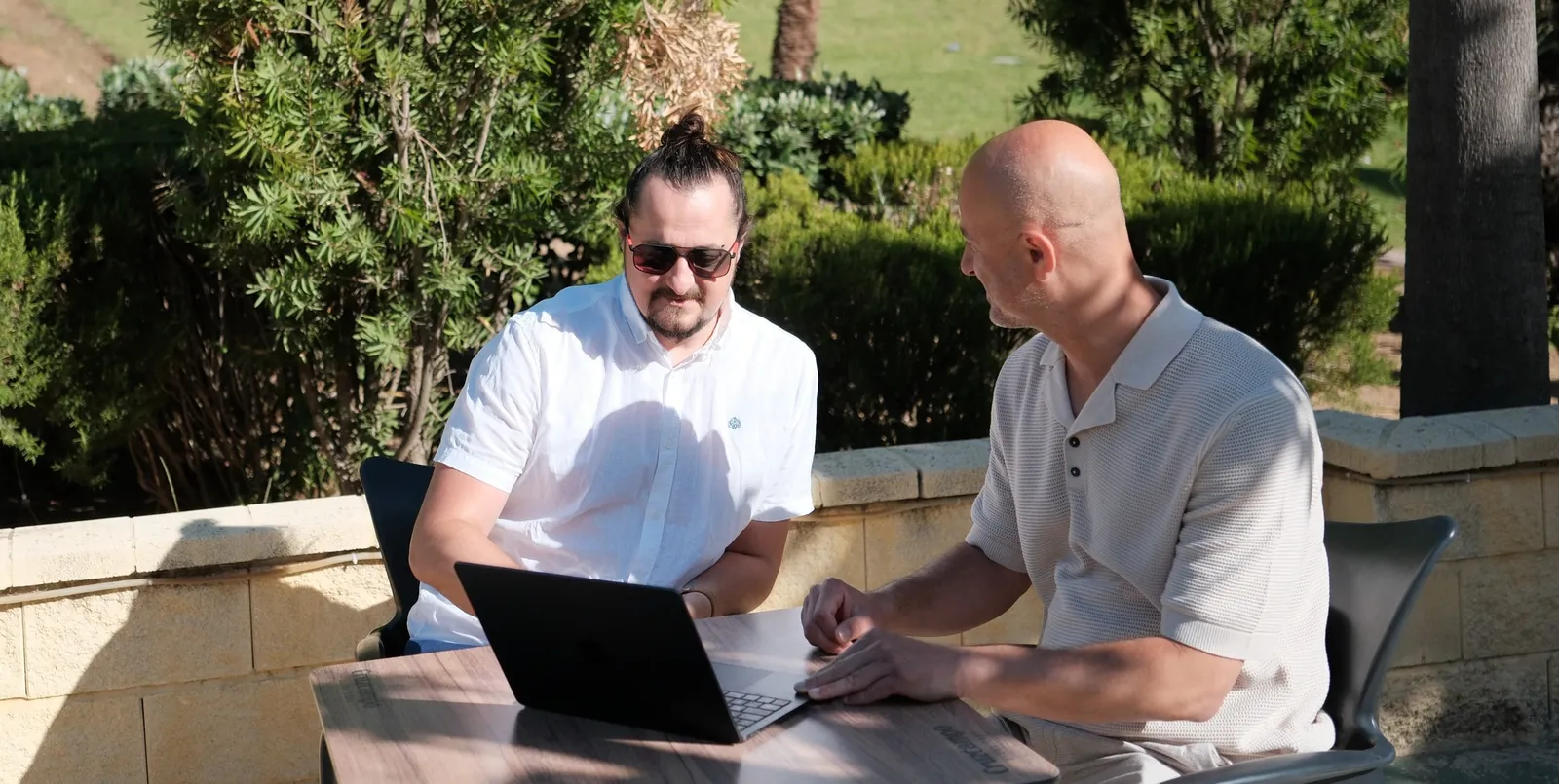
We are about 50 people in around 20 countries, remote-first since before that was common, and ten years into it. The way we work only functions with experienced people who can carry a decision from the first conversation to running software, and who will say what they do not know before somebody finds out. So the page below is mostly about what would be on your desk and who you would sit with. If it does not appeal, that is worth knowing on a Tuesday afternoon and not in month two.

Who we look for

Who the work suits

We stay small on purpose, so who joins matters more than which tools they have used. Four things we look for, in the order we look for them.

  1. Seniority and judgement

    You can take an ambiguous problem, decide what matters, and answer for the result. Nobody here will tell you the next step, because nobody here knows it either until somebody works it out.

  2. Depth in a discipline

    Operations research, decision-making under uncertainty, applied AI, formal methods, or senior product engineering. Depth in at least one, and enough respect for the others to know when yours is the wrong tool.

  3. Comfort with uncertainty

    You can say which of your claims is a hypothesis and which is proved, say where a result stops applying, and change your mind when the evidence does, in writing, where colleagues can see.

  4. Willingness to publish

    You are prepared to write your thinking down and put the method and the evidence where other people can check it, including the results that went against you.

The work

What would be on your desk

The company does three kinds of work: a research lab, musical instruments, and decision systems for companies. Here are four of the places that lands on somebody's desk, and every one of them has something public attached. So you can read the code, the proofs or the writing before deciding whether any of it is your idea of a good year.

Decisions modelled as methods

Scheduling, acceptance, triage and portfolio calls, framed as objectives and constraints and then built into something a team uses on a Monday. Our operations-research library is public: 251 functions across 30 namespaces, zero dependencies.

Decision systems

Systems other people run for years

Nine internal systems behind a sports platform serving more than 100 million people, built and still operated by us, and Gitrevio, which we build and run ourselves. Software judged by whether it holds up at four in the morning.

The work

Proof where testing runs out

Rainbow is our dependent-type theorem prover in Clojure, with a ~1,200-line trusted kernel against which 222 of 222 catalogued algorithms carry a machine-checked proof. The repository is not public yet. We send the sources to anyone who asks.

Rainbow

The working model

The shape of the job

Decide whether this suits you before we both spend time. It suits fewer people than it sounds like it would.

You work with autonomy and are trusted to make calls in your area. The other side of that is accountability: the people who frame a problem stay close to it through proof, build and operation, so a call you made in March is still yours in October.

Because we work across countries and time zones, written thinking and clear interfaces matter more than being in a room. For the research roles, publishing is part of the job, and we expect people to state what they tested and where it does not apply, in public, under their own name.

The seats on an engagement are an engagement partner, a decision scientist, a senior product engineer, a data engineer, a product designer or domain specialist, and, where the risk earns one, a formal-methods specialist. Depth is added when the problem needs it, so a small team stays small. What each seat is answerable for is written out in how we work.

How we hire

How we hire

Four steps, no puzzles, and you know where you stand at each one. The whole thing takes two to three weeks when both sides are prompt.

  1. Introduction

    You tell us what you do well and what you want to work on. You hear back within the week whether there is a plausible fit.

  2. Conversation

    A senior person talks through your experience and how you think about problems, evidence and trade-offs. It is a conversation, and it goes both ways.

  3. Real problem

    We look at a problem together, close to the work we do, for a couple of hours. It is the part of the process that tells both sides the most.

  4. Decision

    We make a clear decision and explain it. If it is not a fit now, the decision says so, with the reason.

Open roles

Open roles appear here when they are open

We do not keep permanent listings open to collect applications. When we are hiring for a specific role, it appears on this page. In the meantime, capable people are welcome to introduce themselves. If what you do fits how we work, we would rather know you exist before a role opens than after it closes.

Read us before you apply

You can read what it is like here without talking to anyone. The engineering handbook is the standards you would be held to, published unedited, including the parts about productivity and what we expect you to know. The engineering archive runs to 104 articles under the names of the people who wrote them. Between the research hub and the lab there are 23 labelled entries, each one saying what its evidence is and where the result stops applying, and one of them records a result that went against us. So the claim that publishing is part of the job is one you can count before you apply.

Work with us

Tell us what you do well

A short introduction is enough to start. If there is a plausible fit, a senior person will reply within the week.